
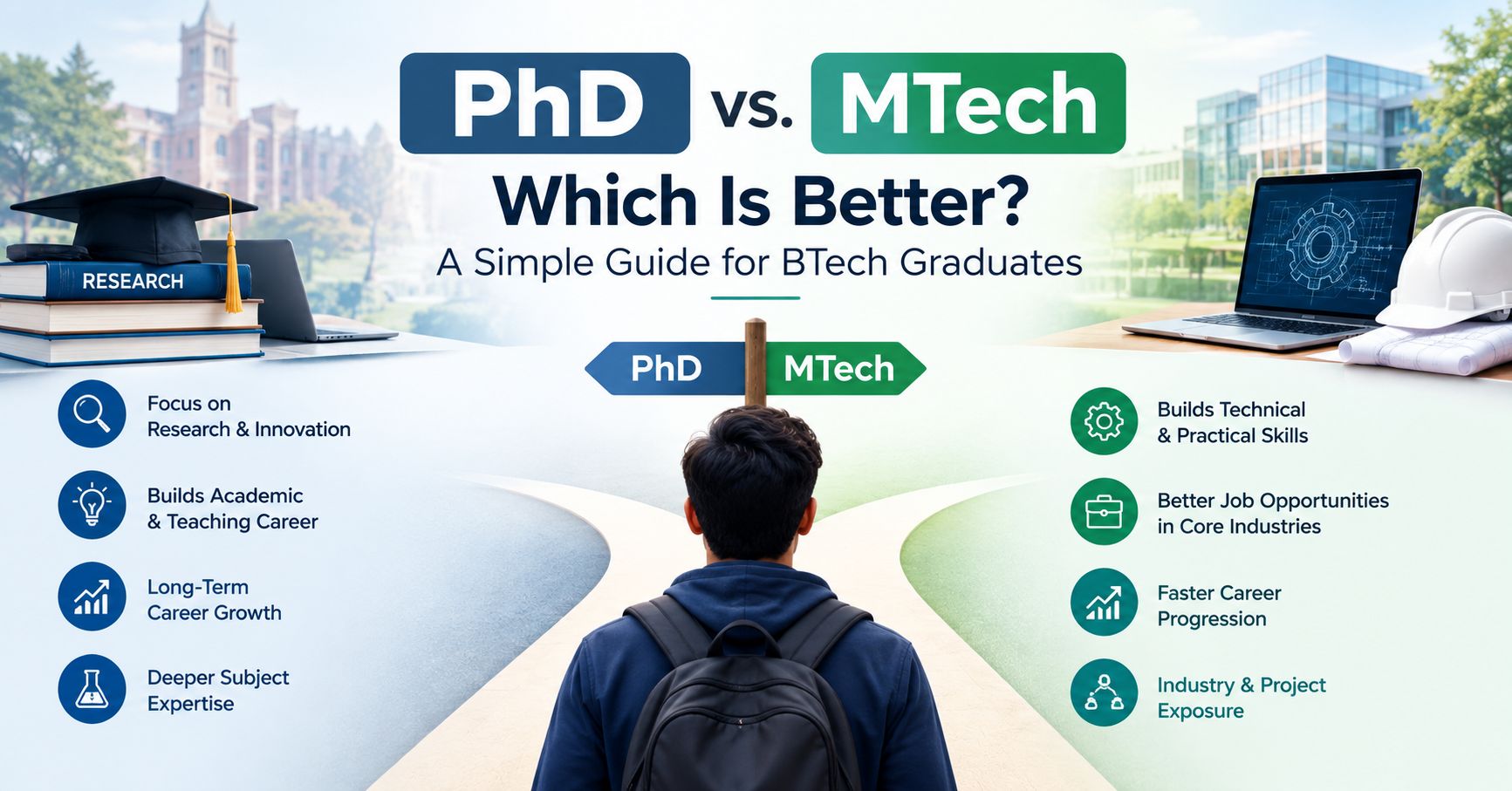
You have finished your BTech, the farewell photos are still on your phone, and one question keeps popping up: what next? Some friends are preparing for GATE, some have joined a company, and a few are talking about research. Sooner or later, almost everyone lands on the same doubt: PhD vs. MTech, which is better?
The honest answer is that neither one wins for everyone. It depends on your goals, your patience, your budget, and the kind of work you enjoy. In this guide, we will break down PhD vs. MTech in plain language so you can decide with a clear head. If you want personal help along the way, the team at AdmissionsDekho guides students through exactly this decision.
What Is an MTech?
MTech is a two-year postgraduate engineering degree. You go deeper into one branch, such as VLSI, structural engineering, machine learning, or thermal engineering. Most students get in through GATE, and institutes like IITs and NITs give GATE-qualified students a monthly stipend (around ₹12,400 at the time of writing).
The course is structured. You attend classes, work in labs, and finish with a thesis in the last year. It is practical and job-focused, and it is the natural upgrade for anyone who wants better technical skills and a stronger resume. You can explore colleges and specializations on the AdmissionsDekho engineering courses page.
What Is a PhD?
A PhD is a research degree. It usually takes 3 to 5 years, sometimes more. After a short coursework phase, there is no fixed syllabus. You pick a problem, read hundreds of papers, run experiments, publish your findings, and finally defend a thesis. In simple words, you stop learning what is already known and start creating new knowledge.
Admission usually comes through UGC NET-JRF, CSIR NET, GATE, or the institute's own test, followed by an interview. Your research proposal and your guide matter a lot. If you want a clearer picture of eligibility and universities, the PhD admission guidance page is a good starting point.
Difference Between PhD and MTech at a Glance
Here is the difference between PhD and MTech in one quick table:
| Duration | 2 years | 3–5+ years |
| Focus | Advanced skills and applications | Original research |
| Entry | GATE or university test | NET/JRF, GATE, interview |
| Stipend | Only for GATE seats | Fellowship of ₹37,000+ per month |
| Best for | Industry, PSU jobs | Teaching, R&D, scientist roles |
So when people ask which PhD vs. MTech is better, the first thing to understand is that these two degrees are built for different journeys.
MTech After BTech or PhD: Which Route Should You Take?
This is where most students get stuck. Here is the practical view of MTech after BTech or PhD.
MTech is the safer stepping stone. It gives you two years to test your interest in a subject, build a good profile, and even publish a paper or two. If research excites you by the end, you can still go for a PhD later, and you will be much better prepared.
A direct PhD after BTech is possible in many IITs and NITs, but it suits a specific type of student: someone with a strong GATE score, a solid academic record, and real research exposure, such as internships or publications. If you are not sure you want to spend five years on one topic, the MTech-first path saves you from a costly mistake.
Simply put, in the PhD vs. MTech debate, which is better, MTech is the lower-risk choice and PhD is the higher-commitment one.
PhD vs MTech Salary: What Can You Expect?
Let us talk money, because everyone does. The PhD vs. MTech salary picture looks different at different stages of life. These are rough ranges, and real numbers vary by college, branch, and company.
MTech salary: Freshers in private companies usually start between ₹4 and ₹10 LPA. Graduates from top institutes in fields like computer science or electronics can cross ₹15 LPA. A PSU job through GATE often brings roughly ₹12 to ₹17 LPA in total pay, along with job security.
PhD salary: During the PhD, you earn a fellowship, around ₹37,000 to ₹42,000 per month for JRF and SRF (check the latest notification). After the degree, an assistant professor at a government institute earns roughly ₹80,000 to ₹1.3 lakh per month with allowances. In industry research roles, packages range from ₹12 LPA to ₹30 LPA or more, especially in AI, semiconductors, and pharma.
So an MTech graduate starts earning sooner, while a PhD holder starts later but often reaches senior research and leadership positions with better long-term growth. When you look at PhD vs. MTech, which is better purely for early salary, MTech leads. For long-term expertise and specialist roles, a PhD catches up fast.
Career Scope After Each Degree
After MTech, you can join core companies, IT firms, or PSUs like ONGC, BHEL, or NTPC, or work as a lecturer in engineering colleges. You can also prepare for government exams or start your own venture.
After a PhD, you can become a professor, a scientist at DRDO, ISRO, or CSIR labs, or a research lead in companies. Many PhD holders also move abroad for postdoctoral positions, and global universities value this degree highly.
Notice that teaching is one area where the PhD has a clear edge. For most university faculty posts, a PhD is now mandatory.
PhD vs. MTech: Which Is Better for You? Ask Yourself These Questions
Forget what your friends or relatives say. Answer these honestly:
Choose MTech if you want to start earning in two years, prefer hands-on work, are aiming for a PSU or corporate job, or are still exploring your interests.
Choose a PhD if you enjoy reading, questioning, and solving one problem for years; dream of becoming a professor or scientist; and can handle slow progress and failed experiments.
Both paths are respectable. The MTech vs. PhD choice is really a question of temperament, not intelligence.
Still confused? Sign up on AdmissionsDekho and get your profile evaluated by education experts, who can compare colleges and options based on your marks, budget, and goals.
Mistakes to Avoid While Deciding
Many students pick a degree only because their seniors did. Others chase a PhD for the "Dr." title without loving research and quit midway. Some choose MTech from a weak college just to delay job hunting.
Do not decide under pressure. Check the college's approvals, faculty, placement record, and research output first. When you compare PhD vs. MTech, which is better, always compare it against your plans, not somebody else's.
Final Verdict: PhD vs. MTech—Which Is Better?
If you want a quicker career, industry skills, and a stable salary, MTech is usually the smarter step. If you want to research, teach at a university, or work in deep science, a PhD is worth every year. And if you are undecided, do the MTech first and keep the PhD door open.
The right answer to PhD vs. MTech, which is better, is the one that matches your goals. Take your time, talk to seniors, and get expert advice. You can also book a free counselling session with AdmissionsDekho to make a confident decision.