
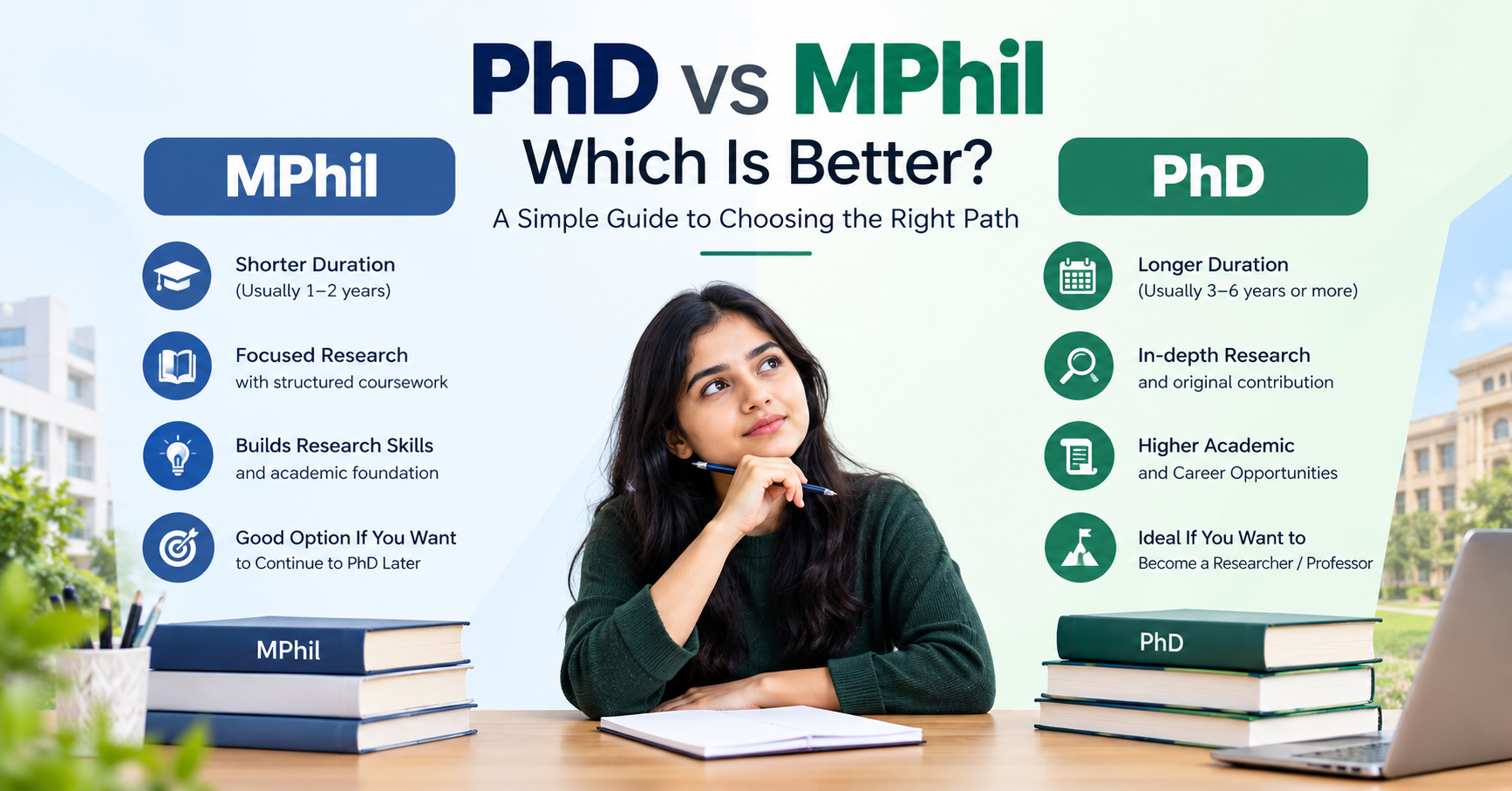
You have finished your master's degree, and now everyone around you has an opinion. Some say go for research right away; others say take a smaller step first. So the big question is: PhD vs. MPhil- which is better? The honest answer is that it depends on your goals, your time, and the career you want to build.
In this guide, we break everything down in simple language. By the end, you will know exactly which is better for your situation. If you want personal help while exploring your options, you can create your free account on AdmissionsDekho and get guidance in one place.
One quick update before we start. In India, MPhil admissions have been discontinued under NEP 2020 and the UGC regulations of 2022. Many people still hold this degree, and it is still offered in some countries, so the comparison remains useful.
What Is an MPhil?
MPhil stands for Master of Philosophy. It is a research-based postgraduate degree that sits between a master's and a doctorate. It usually takes one to two years and includes coursework, a research methodology paper, and a short dissertation.
Think of it as a training ground. You learn how to frame a research question, review existing studies, and write in an academic style. Many students used it to test whether a research career suited them before committing to years of doctoral work.
What Is a PhD?
A PhD, or Doctor of Philosophy, is the highest academic degree. It asks you to produce original research that adds something new to your field. You work under a supervisor, complete coursework, present your progress regularly, write a full thesis, and defend it in a viva.
It takes a lot longer and demands a lot more, but it also opens the widest doors in teaching, research, and specialized industry roles.
Difference Between PhD and MPhil
Let us look at the difference between a PhD and an MPhil side by side.
| Level | Pre-doctoral | Doctoral (highest) |
| Duration | 1 to 2 years | 3 to 6 years |
| Research depth | Short dissertation | Full original thesis |
| Purpose | Research training | Original contribution to knowledge |
| Availability in India | Discontinued | Available |
In short, an MPhil teaches you how research works, while a PhD expects you to actually create new knowledge. This is the core of the MPhil vs PhD debate, and it shapes every other point below.
PhD vs. MPhil Eligibility
Eligibility is often the first filter, so let us keep it clear. For most Indian universities, PhD vs. MPhil eligibility looks similar at the entry stage. You need a relevant master's degree with roughly 55% marks, with relaxation for reserved categories. Universities may also ask for a valid national or university-level entrance score, such as UGC NET, or their own test, followed by an interview.
For a PhD, you also need a clear research proposal. Supervisors want to see that your topic is realistic and worth studying. Under the latest UGC rules, some students with a four-year undergraduate degree and strong marks can also apply directly. Always check the exact criteria of your chosen university, since small details can differ.
PhD vs MPhil Career Opportunities
Now the part everyone cares about. When we compare PhD vs. MPhil career opportunities, the gap is quite visible.
With an MPhil, you could:
- Teach at colleges, though many now expect NET or a PhD
- Work as a research assistant or junior researcher
- Take up content, policy, or academic support roles.
- Use it as a stepping stone toward a doctorate.
With a PhD, you could:
- Become an assistant professor and grow to associate professor and professor.
- Join research labs, think tanks, and government research bodies.
- Work as a scientist, data expert, or R&D specialist in companies.
- Consult, publish, and lead projects in your field.
Since the MPhil is no longer offered in India, a PhD is now the main route for anyone who wants a serious academic career. Abroad, the doctorate also carries far more weight for senior research positions.
PhD vs MPhil Career: Growth and Salary
Looking at the PhD vs. MPhil career path over the long run, a doctorate usually wins on growth. Faculty positions at good universities, senior research roles, and leadership posts often list a PhD as a basic requirement. Salaries in these roles tend to be higher, and promotions come with more authority.
An MPhil can still give you a decent start, especially in teaching and research support. But growth may slow down without a doctorate, which is why many MPhil holders eventually enroll in a PhD anyway.
That said, a degree alone never guarantees success. Your publications, skills, and network matter just as much.
Time, Cost, and Effort
When students search for MPhil vs. PhD, they often forget to count time and money. An MPhil is shorter, so it costs less and gets you into the workforce sooner. A PhD can take four to six years, and living costs add up unless you receive a fellowship like JRF.
The good news is that many PhD students get funding, stipends, or teaching assistantships, so the burden is not always as heavy as it sounds. Do check the funding options before you apply.
PhD or MPhil: Which Is Better for You?
So, PhD or MPhil: which is better? Here is a simple way to think about it.
Choose a PhD if:
- You love research and can stay committed for several years.
- You want to become a professor or a full-time researcher.
- You are aiming for high-level roles in science, policy, or industry R&D
Choose an MPhil (where available) if:
- You want a taste of research before a big commitment.
- You need a shorter, lower-cost academic qualification.
- You plan to enter a PhD later and want a strong foundation.
If you are still confused about PhD vs. MPhil, which is better, talk to a mentor, read a few research papers in your field, and ask yourself whether you enjoy the process itself. AdmissionsDekho can also help you shortlist universities and understand admission steps, so you do not have to work through everything alone.
Final Thoughts
There is no one-size-fits-all answer to which is better: PhD vs. MPhil. An MPhil offers a gentler entry into research, while a PhD offers depth, authority, and stronger long-term career growth. With MPhil admissions closed in India, most students today will find the doctorate to be the practical and rewarding choice.
Whatever you decide, plan early, check eligibility carefully, and choose a topic you truly care about. Ready to explore your options?
Sign up on AdmissionsDekho and take the first step toward the right program with expert support.