
Ask ten people on the street what a doctorate is, and at least eight will say "PhD". That's exactly why the confusion around the PhD and doctorate difference refuses to die down. Students preparing for higher studies, working professionals eyeing a career switch, and even parents helping their kids choose a path — everyone stumbles on this at some point. So let's clear the fog once and for all, in plain, simple language, without any jargon-heavy detours.
Why People Keep Confusing PhD With Doctorate
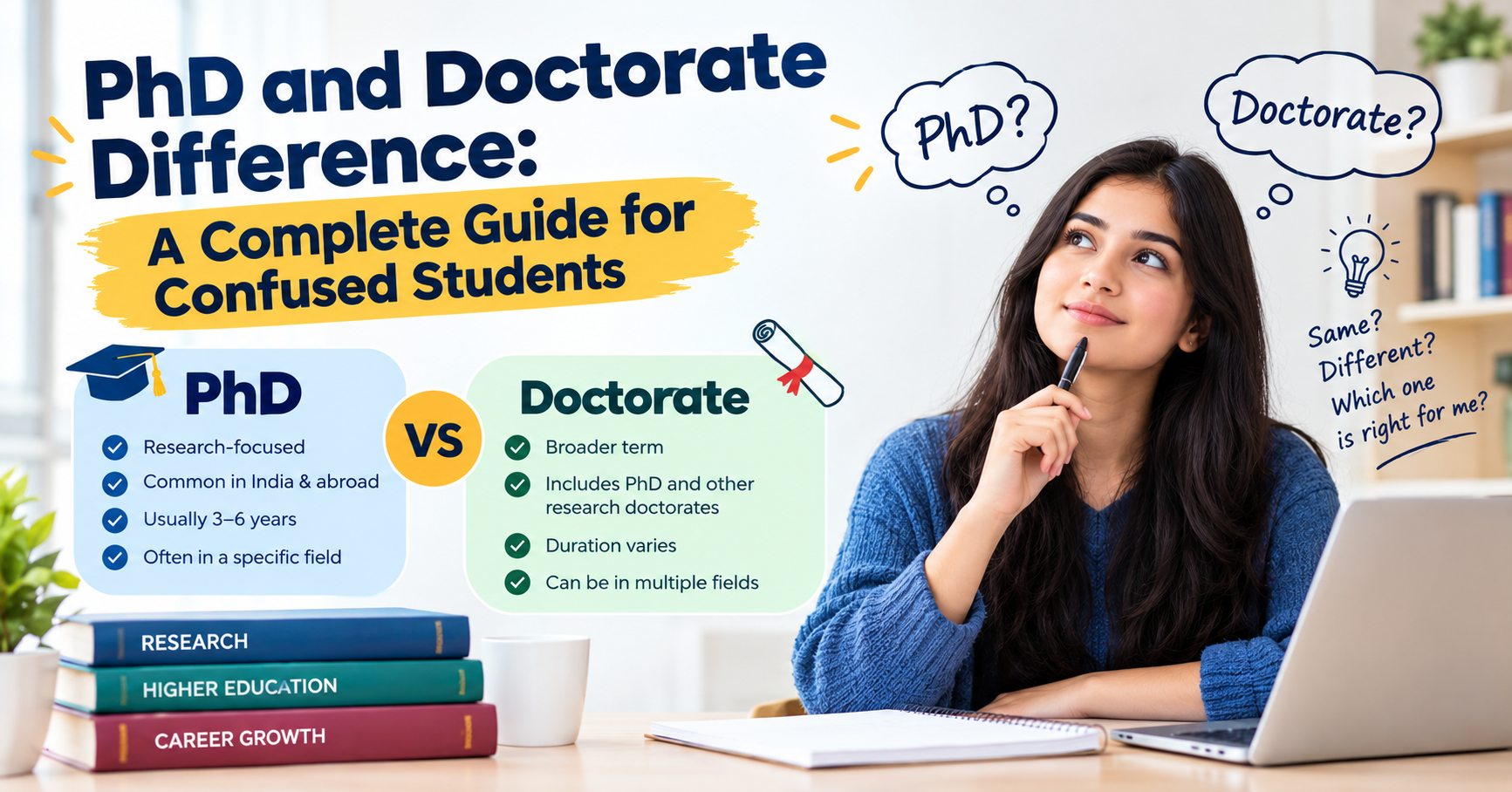
Before jumping into the PhD and doctorate difference, it helps to understand why this mix-up happens in the first place. A PhD is, technically, a type of doctorate. But not every doctorate is a PhD. Think of it like this — every square is a rectangle, but not every rectangle is a square. That's the simplest way to picture the PhD and doctorate difference without getting lost in academic definitions.
'A doctorate' is the umbrella term. It refers to the highest academic degree a university can award in a particular field. Under this umbrella sit several types of degrees — PhD being the most common and widely recognised one, but definitely not the only one.
What's the Difference Between Doctorate and PhD, Really?
If someone asks you what the difference is between a doctorate and a PhD in one line, here's your answer: a doctorate is the broad category, and a PhD (Doctor of Philosophy) is one specific degree within that category, focused heavily on original research.
Other doctorate degrees include:
- EdD (Doctor of Education) — for professionals in education leadership
- DBA (Doctor of Business Administration) — for senior business practitioners
- MD (Doctor of Medicine) — for medical practitioners
- DSc (Doctor of Science) — often awarded for advanced scientific contribution.
- PsyD (Doctor of Psychology) — practice-focused, unlike the research-heavy PhD
So when someone brings up the PhD and doctorate difference, they're really asking how a research-based degree compares to these other, often practice-based, doctoral qualifications.
The Core PhD and Doctorate Difference in Focus
Here's where the PhD and doctorate difference becomes clearer. A PhD is built almost entirely around research. You pick a problem, study it deeply for years, and produce a thesis that adds something new to the world's knowledge. It's theoretical, exploratory, and often abstract.
Professional doctorates, on the other hand, are built for application. An EdD student might research how to fix a real classroom problem in their own school. A DBA candidate might solve an actual business challenge inside their own company. This practical angle is a major part of the PhD and doctorate difference that many people overlook.
Duration, Structure, and Career Path
Another angle to understanding the PhD and doctorate difference is time and structure. A PhD usually takes anywhere from 3 to 6 years, depending on the country, university, and subject. Much of this time goes into independent research, data collection, and writing the dissertation.
Professional doctorates tend to have a more structured timeline, often with coursework mixed in alongside a smaller research project. This is one more layer to the PhD and doctorate difference that matters a lot for working professionals — many choose a professional doctorate precisely because it fits better around a full-time job.
Career-wise, PhD holders often move toward academia, research institutions, or specialised R&D roles. Doctorate holders (non-PhD) often stay within their professional field and use the degree to move into leadership, policy, or consulting positions. This career split is one of the most practical outcomes of the PhD and doctorate difference.
Admission Requirements: Another Layer of the PhD and Doctorate Difference
Admission criteria also reveal the PhD and doctorate difference clearly. PhD programmes usually expect a strong academic record, a research proposal, and sometimes prior research or publication experience. Universities want to see that you can think independently and sustain a long research project.
Professional doctorates, meanwhile, often value real-world experience just as much as academic scores. Years of relevant work experience can sometimes matter more than research background. If you're weighing your options and trying to understand the PhD and doctorate difference before applying anywhere, checking each programme's admission page carefully is a smart first step — platforms like admissionsdekho make this comparison much easier by listing requirements side by side.
Which One Should You Choose?
There's no universal "better" option when it comes to the PhD and doctorate difference — it entirely depends on your goals.
- Want to become a researcher, professor, or scientist? A PhD fits naturally.
- Want to grow within your current profession — education, business, healthcare — while gaining the highest credential in your field? A professional doctorate might serve you better.
Many students exploring this decision reach out to counselling platforms like AdmissionsDekho to get personalised guidance based on their background and career goals, rather than guessing based on internet articles alone.
A Quick Recap of the PhD and Doctorate Difference
To put it simply: doctorate is the parent category; PhD is one specific branch under it, focused on original research. Other branches — EdD, DBA, MD, PsyD — are built more around applying knowledge in a professional setting. Once you understand this, the PhD and doctorate difference stop feeling confusing and start feeling like common sense.
If you're still unsure which path suits you, it helps to talk to people who guide students through this decision every day.
You can sign up on admissionsdekho to get one-on-one guidance on choosing between a PhD and a professional doctorate, based on your interests and career direction.
Whatever you choose, both paths lead to the same title — "Doctor" — just through very different journeys. And now, at least, the PhD and doctorate difference won't leave you second-guessing at your next conversation about higher education.
If you're comparing programmes, exploring universities, or simply trying to figure out your next academic step, Admissionsdekho has resources built exactly for that kind of decision-making. And if you'd rather get direct advice instead of researching alone, you can always create an account here and start the conversation.