
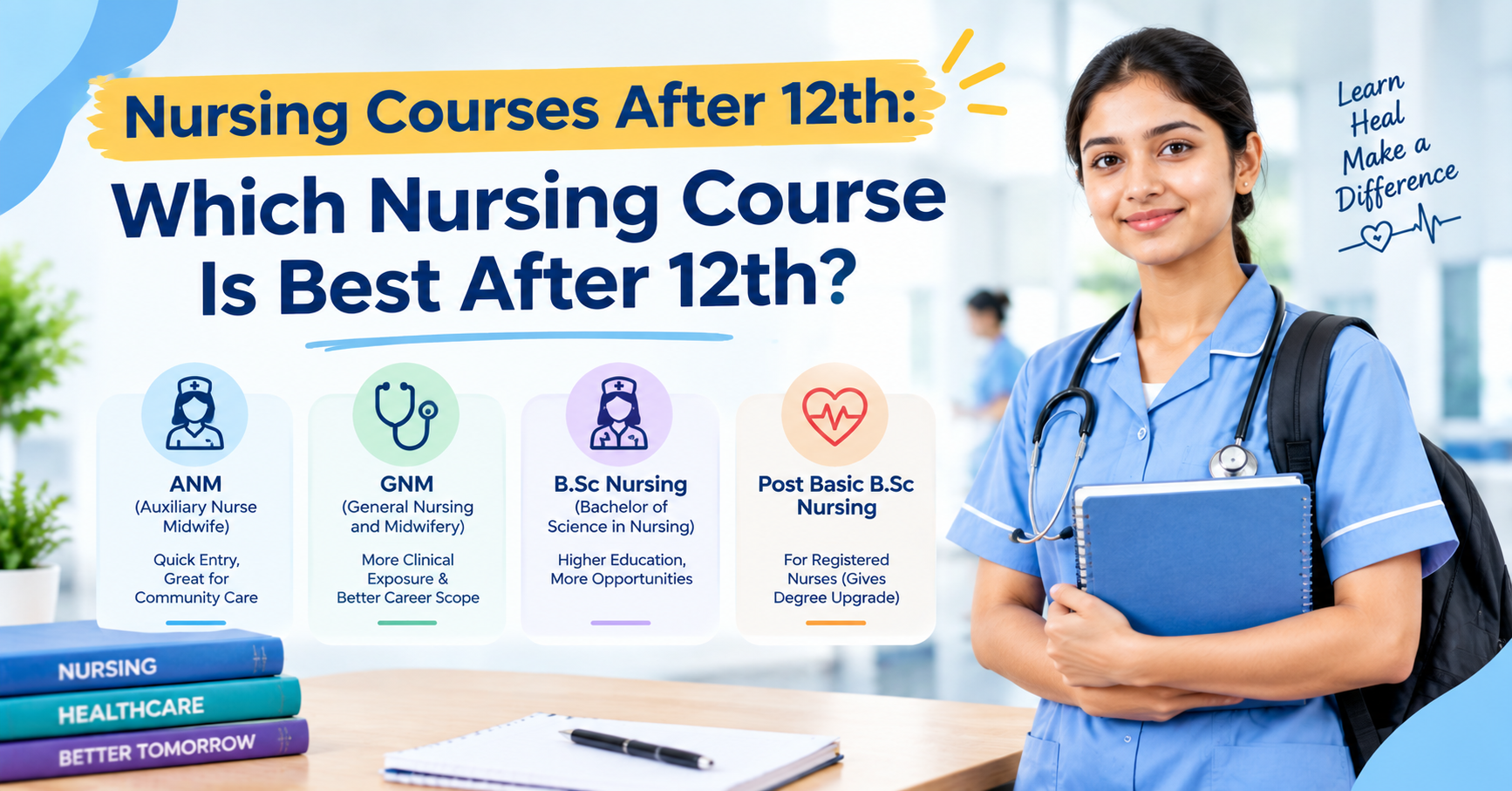
Finished Class 12 and thinking about a career in healthcare? Nursing is one of the safest and most respected options today. But the moment you start searching, you find so many choices that it gets confusing: ANM, GNM, BSc Nursing, diplomas, and more. Each has a different duration, fee, and job scope. In this blog, we explain the popular nursing courses in plain language so you can choose the right path and plan your admission without stress.
Why Nursing Is a Good Career Choice
India needs lakhs of trained nurses. Government hospitals, private hospitals, clinics, nursing homes, schools, and even the armed forces hire them. Countries like the UK, Canada, Australia, and the Gulf nations also look for Indian nurses. Demand is steady, salaries keep improving, and the work earns real respect in society. If you like helping people and can stay calm under pressure, this field can suit you well.
Types of Nursing Courses After 12th
Nursing programmes in India come in three levels: certificate, diploma and degree. Let us look at each one.
1. ANM Nursing Course
ANM stands for Auxiliary Nurse Midwife. The ANM nursing course is a 2-year programme and the quickest way to start working in the health sector. Students learn basic patient care, maternal and child health, first aid, and community health. Most ANM graduates work in sub-centres, primary health centres, and village-level health programmes. In many states, 10+2 in any stream is accepted, though some states ask for 45–50% marks. Fees are usually low, so it suits students with a limited budget.
2. GNM Nursing Course
GNM means General Nursing and Midwifery. The GNM nursing course runs for 3 years plus 6 months of internship. It is a diploma-level programme that gives you strong hospital training. Most colleges ask for 10+2 with English, and many prefer science students, although some also accept arts or commerce. After GNM, you can work as a staff nurse, and later you can do Post Basic BSc Nursing to get a degree.
3. BSc Nursing
BSc Nursing is a 4-year degree and the most preferred choice for students who want long-term growth. Eligibility is 10+2 with Physics, Chemistry, Biology, and English, usually with at least 45–50% marks. The syllabus covers anatomy, physiology, microbiology, nutrition, medical-surgical nursing, child health, mental health, and community health, along with clinical training. After graduation, you can apply for staff nurse jobs, nursing officer posts in government exams, or go for an MSc in Nursing and other higher studies.
4. Post Basic BSc Nursing
This is a 2-year programme for GNM-qualified nurses who want to upgrade to a degree, often while continuing their job.
| ANM | 2 years | Certificate | Quick start, low budget |
| GNM | 3 years + 6 months internship | Diploma | Hospital jobs, practical training |
| BSc Nursing | 4 years | Degree | Career growth abroad, higher studies |
| Post Basic BSc | 2 years | Degree | GNM nurses upgrading |
Which Nursing Course Is Best After 12th?
Students often ask which nursing course is best after 12th. The honest answer is that it depends on your marks, budget, and goals.
- If you studied PCB and want the strongest career growth, a BSc Nursing is usually the best pick.
- If you want a job-oriented programme with good hospital training, the GNM nursing course is a solid middle path.
- If you need to start earning early or have budget limits, the ANM nursing course works well.
When you compare all the nursing courses, always check that the college is approved by the Indian Nursing Council (INC) and your state nursing council. Without approval, your certificate may not be valid for jobs or registration.
Eligibility for Nursing Courses
Rules differ slightly from state to state, but the general requirements are:
- Passed 10+2 from a recognised board (PCB for BSc Nursing)
- Minimum marks, usually 40–50% depending on the course and category
- Minimum age of 17 years at the time of admission
- Medical fitness
Always read the latest admission notice of your state or college, because eligibility and dates can change every year.
How to Fill Out Nursing Admission Forms
Here is a simple step-by-step way to handle BSc Nursing admission:
- Check your eligibility. Confirm your subjects, marks, and age.
- Shortlist approved colleges. Make a list of colleges offering nursing courses in your state and outside it. Check INC approval, hospital tie-ups, faculty, and placement record.
- Know the selection method. Some colleges admit on 12th-class merit, while others use entrance exams or state counselling. Check the current year's notification.
- Fill the application form. Do it on time and keep a copy of the submitted form.
- Attend counselling or verification. If your name comes in the merit list, go for document verification and seat allotment.
- Pay the fee and confirm your seat. Keep all receipts safe.
Documents You Will Need
- 10th and 12th marksheets
- Photo ID (Aadhaar card)
- Passport-size photographs
- Category certificate (if applicable)
- Transfer or migration certificate
- Medical fitness certificate
- Domicile certificate (for state quota)
Fees and Budget
Fees of nursing courses depend on the college, city, and whether it is government or private. Government colleges are much cheaper and are worth trying first. Private BSc Nursing colleges can cost a few lakh rupees over four years, while ANM and GNM are usually lower. Also plan for hostel, uniform, books, and clinical training expenses. Some states and colleges offer scholarships, so ask about them before you decide.
Practical Tips Before You Apply
- Start early. Good seats fill up quickly, and many forms open right after board results.
- Do not depend on agents who promise guaranteed seats. Verify everything yourself.
- Visit the college hospital if you can. Good clinical exposure matters more than a fancy building.
- Ask about internship, stipend, and placement support.
- Keep two or three backup options in case your first choice does not work out.
How to Become a Nurse in India: A Simple Roadmap
If you are wondering how to become a nurse in India, the path is quite clear:
- Complete Class 12, preferably with science (PCB).
- Choose ANM, GNM, or BSc Nursing based on your goals.
- Complete the classroom and clinical training along with the internship.
- Register with your State Nursing Council to get your nursing licence.
- Apply for jobs in government or private hospitals, or prepare for exams like state staff nurse recruitment and nursing officer exams.
- Keep learning through specialisation courses, PG programs, or abroad licensing exams if you want to work overseas.
Whichever nursing course you pick, registration with the state council is a must before you can practise as a nurse.
Get Admission Guidance With AdmissionsDekho
Choosing a course and a college is a big decision, and many students lose time because of wrong information. At AdmissionsDekho, you can explore colleges, understand eligibility, and get help with the admission process in one place. If you are planning your nursing admission, you can register on AdmissionsDekho here and get guidance for the next steps.
Conclusion
Nursing is a stable and meaningful career with strong demand in India and abroad. Nursing courses give you different entry points depending on your marks and budget: ANM for a quick start, GNM for practical hospital training, and BSc Nursing for the widest growth. Check eligibility early, choose only approved colleges, keep your documents ready, and apply on time. If you want personal help with shortlisting colleges and applying, you can sign up on AdmissionsDekho and take the first step toward your nursing career.